 Football
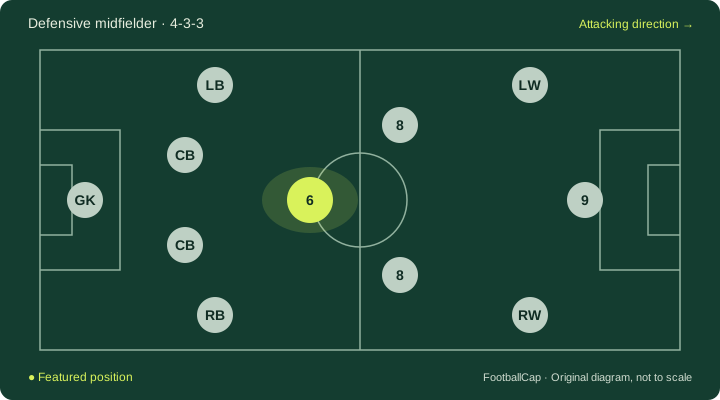
What is a defensive midfielder, and where do they play?
Plays at the base of midfield, connecting the defense with players farther forward. No. 6 is a common role name; the player does not need to wear that jersey number.
The diagram uses a 4-3-3 setup, attacking from left to right. Yellow markers identify the position being discussed; they are not average match coordinates. For left/right pairs, the top of the diagram is the attacking team’s left side.
Responsibilities in three phases
- In possession: Offer passing angles ahead of the center backs, change the tempo and direction of buildup, and receive between lines of pressure when possible.
- Out of possession: Screen access to the middle, track runners, and protect the space in front of the center backs.
- Transitions: Anticipate where loose balls may fall and restrict counterattacks before the back line is forced into direct duels.
The tactical discussion draws on Coaches’ Voice — Number six position. The wording and exercise below are FootballCap’s own.
Position versus role
A ball-winner focuses on regaining possession; a deep-lying playmaker directs play from deeper positions. These are emphases, not completely separate positions. A double pivot shares responsibility between two players.
Historical data: the Midfielder group
| Measure in the historical dataset | Result |
|---|---|
| Records labeled Midfielder | 1257 |
| Records with height greater than zero | 1231 |
| Records without a valid height | 26 |
| Median height, cm | 180 |
Source: Players — Pappalardo et al. (2019), CC BY 4.0. FootballCap recalculated these values from the original file. This is a transformed summary, not a table supplied by the authors.
Limitations: The dataset uses four broad labels and does not isolate DM / CDM / No. 6. These are historical player records pooled across competitions, not appearances or current-season statistics. Height does not measure tactical ability and is not a selection threshold. Do not use this figure as a standard height for this position. See the methods, four groups, and downloads.
What to watch
Read passing accuracy alongside direction, distance, and pressure. A high completion rate built on sideways passes may not solve the problem of progressing the ball.
A position-reading exercise
Place a No. 6 between the center backs and two No. 8s. Block the direct pass into the No. 6 and try a sideways adjustment instead of simply moving toward the ball. When a No. 8 loses possession, identify the first passing lane the No. 6 should screen.
Use three columns: what you see, alternative options, and what you cannot yet conclude. These are original exercises; repetitions on the tactics board are not player-performance data.
Keep exploring: double pivot · All football positions · Open the tactics board.
References
- Coaches’ Voice — Number six position
Source checked: 2026-09-09 - Pappalardo et al. (2019) — Players, CC BY 4.0
Source checked: 2026-09-09 - Creative Commons Attribution 4.0 License
Source checked: 2026-09-09
FootballCap summarized Pappalardo et al. (2019), Players, CC BY 4.0, excluding missing heights and calculating medians. Coaching sources are paraphrased and linked; their images and videos are not reproduced.