Each level requires three separate assessment scores above 85%: at least 18 correct answers out of 20. Questions are sampled from each level’s bank and may recur. Passing attempts do not need to be consecutive.
Optional knowledge reminders: every 5 or 10 minutes, or off. Reminders pause during assessments.
Curriculum, study method & limitations
Foundation: Describe space, roles and common law situations accurately.
Map the field before naming the tactic
Separate positions, roles and formations
Describe incidents without inventing a rule
Game Reader: Recognize buildup, pressure and changes of possession.
Find a receiver beyond the first pressure
Coordinate the press and screen the escape
Read defensive height and transitions
Tactical Analyst: Explain attacking mechanisms, cover and set-play tradeoffs.
Create and exploit an advantage out wide
Attack while preparing for the next loss
Analyze a set piece beyond the first contact
Evidence Analyst: Interpret metrics and build a traceable observation log.
Use expected goals without false certainty
Interpret pressure data in context
Build an evidence log instead of a highlight opinion
Expert Track: Deliver a clear, qualified analysis of an unfamiliar sequence.
Deliver a clear explanation without a script
Test an explanation against alternatives
Build an analyst’s portfolio and review your limits
Use full-match footage you can legally access. Pause before a decision, predict the next action, then compare with what actually happens. Reference IFAB, FIFA Training Centre, UEFA, Coaches’ Voice and Hudl/StatsBomb reading linked throughout the lessons.
This is an independent self-study course, not an accredited coaching qualification or a guarantee of employment. Tests check knowledge; practical analysis and commentary require observation, repeated delivery and feedback. Progress is stored in your browser and can be exported. There is no account or server-side exam verification.
All teaching text, hypothetical questions and diagrams are original FootballCap material. External sources remain the property of their publishers; read them through the provided links.
Progress saved on this browser · 0/15 lessons
LESSON · 1
Map the field before naming the tactic
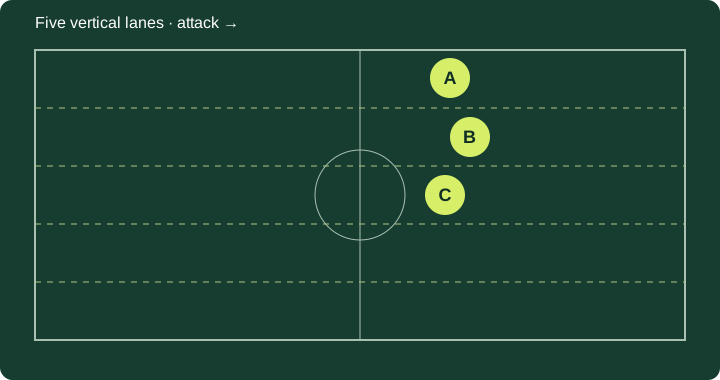
A useful analysis starts with a shared map. Width describes the lateral spread of the team; depth concerns its vertical spacing. The final third is the attacking third of the field. A five-lane model divides the field into two wings, two half-spaces and a central lane. These are analytical labels, not extra markings or rules.
In the diagram, green attacks toward the right. Player A occupies a wing; B is inside the wing. Their positions may stretch a defender in different directions, but location alone does not make either player available. Check the ball carrier, the defender between them and the receiver’s orientation. A static diagram cannot tell you the speed of a pass.
Practice describing a picture before interpreting it. Say who moved, from where, and which defender responded. Then propose what space became available. Avoid saying that a half-space is automatically dangerous: a player can stand in a useful lane while remaining tightly marked.
Worked observation: the left winger stays near the touchline while a midfielder moves into the neighboring inside channel. The full-back must decide whether to follow the winger or protect that inside route. Describe both players relative to the ball and the defenders, not just their listed positions. If the ball carrier cannot access either player because the passing lane is blocked, the spacing is only a potential advantage. Compare the same arrangement before and after a switch to the opposite side. Does the nearest defender now have farther to travel? Record the change before calling the move effective.
Study routine: read the explanation, draw the relationships from memory, and inspect at least three relevant sequences in legally accessible match footage. Answer the practice questions, write an evidence-based observation, then explain it aloud without reading your notes. Return later and test whether you can reproduce the reasoning in a different match. Allow additional observation time; finishing the page is not the same as mastering the skill.
Illustrative positions, not tracking data. Green attacks right.
On the tactics board, show width and depth with four players. Write 100 words explaining one available passing lane and one blocked lane. Then explain the same picture aloud without using a formation label.
 Football