 Football
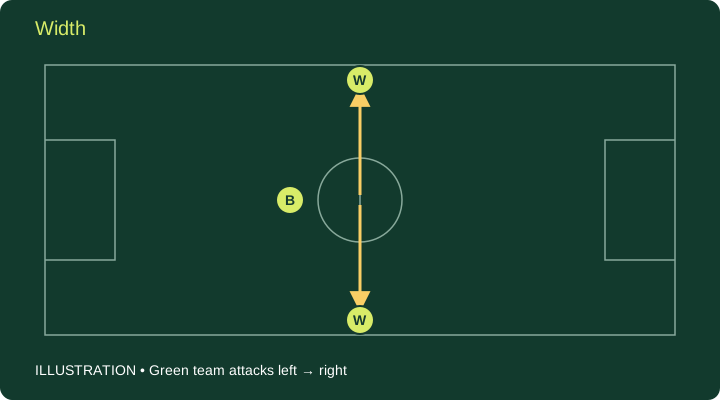
Width describes how a team spreads across the field. In possession, a player near the sideline can offer another passing option or force opponents to defend a wider area.
Reading the diagram
In this original example, two green players hold the flanks. If a white player follows one of them, identify the space left behind and the teammate covering it.
This original FootballCap diagram does not depict a real match. Green and white markers distinguish the teams. Solid lines show movement; dashed lines show passes where present. Positions are not drawn to real-world distance scale.
Common misconceptions
A wide position does not automatically create a safe pass. The ball carrier may be under pressure, while the passing lane toward the sideline may be blocked.
Try it yourself
Move the wide player inside, then return them to the starting position. Record which passing options change. Compare an opponent following the move with one holding their position.
Keep observations separate from explanations. Test tactical ideas on the tactics board. For metrics, establish the definition and data source before calculating.
Related terms
References
- FIFA Training Centre — Zonal restrictions
Source checked: 2026-09-09
Links for further reading; source images, videos, and data are not reproduced.