 Football
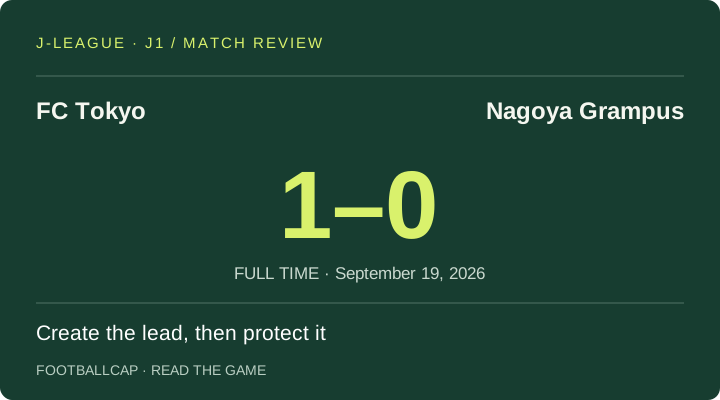
FC Tokyo beat Nagoya Grampus 1–0 on September 19, with Kota Tawaratsumida scoring the only goal at MUFG Stadium. Tokyo then had to protect their advantage with ten players after Takahiro Ko received a second yellow card.
A run that created its own opening
The league record places the goal in the 56th minute and Ko’s dismissal in the 68th. Tokyo’s official match review describes Tawaratsumida carrying the ball forward from deep in his own half, moving toward the right as opponents followed him, and finding room for a right-footed finish.
The value of a carry is easy to miss when analysis concentrates on passing. A player advancing with the ball can force defenders to make new decisions: step toward the carrier, continue tracking a runner, or protect the space behind.
Why the carrier changes the picture
A pass transfers the ball between positions. A carry moves the ball and its possessor together, potentially drawing an opponent away from another responsibility. Once that opponent commits, a shooting lane or a pass may become available.
This does not mean every long run is a good choice. The attacker must recognize when support is available and when holding the ball allows defenders to recover. In this case, the club’s account identifies a run and a shooting opening; it does not provide tracking coordinates for every defender.
A different job after the dismissal
Tokyo’s substitution record shows Kento Hashimoto replacing Marcelo Ryan after the red card. Further changes followed as Tokyo kept the score at 1–0.
When defending with ten, compactness can help reduce the spaces opponents want to play through. But the block also needs an outlet. Otherwise, each recovery may become a clearance that starts the next attack against it.
That is the viewing question for the final phase: could Tokyo’s first pass after winning the ball give the team time to move out, or did it immediately return to Nagoya?
The match had two distinct achievements: creating the lead through an individual advance and preserving it after the personnel balance changed. Read more about transitions and follow the J-League collection.
References
- J.League — official scoring and disciplinary record
Source checked: 2026-09-21 - FC Tokyo — official match result and substitutions
Source checked: 2026-09-21 - FC Tokyo — match review and interviews
Source checked: 2026-09-21
Match facts were checked against the sources below on September 21, 2026. Tactical explanations are FootballCap interpretations of published reporting, not independent full-match or tracking analysis.