 Football
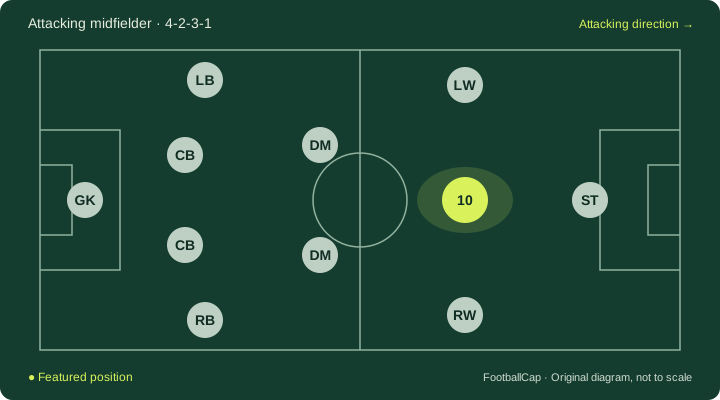
What is a attacking midfielder, and where do they play?
Usually receives behind the opposing midfield and underneath the striker. No. 10 describes a role; not every team stations a player permanently in this area.
The diagram uses a 4-2-3-1 setup, attacking from left to right. Yellow markers identify the position being discussed; they are not average match coordinates. For left/right pairs, the top of the diagram is the attacking team’s left side.
Responsibilities in three phases
- In possession: Find receiving pockets between the lines, create decisive passes, and support runs into shooting positions.
- Out of possession: Screen passes into the holding midfielder or join the pressing line according to the team’s structure.
- Transitions: After a turnover, identify the opponent’s nearest escape route before deciding whether to press or recover into the team’s block.
The tactical discussion draws on Coaches’ Voice — Number 10. The wording and exercise below are FootballCap’s own.
Position versus role
A No. 10 can drift into a half-space. Standing between the lines is not an advantage by itself if the passing angle is blocked or the receiver has no next action.
Historical data: the Midfielder group
| Measure in the historical dataset | Result |
|---|---|
| Records labeled Midfielder | 1257 |
| Records with height greater than zero | 1231 |
| Records without a valid height | 26 |
| Median height, cm | 180 |
Source: Players — Pappalardo et al. (2019), CC BY 4.0. FootballCap recalculated these values from the original file. This is a transformed summary, not a table supplied by the authors.
Limitations: The dataset uses four broad labels and does not isolate AM / CAM / No. 10. These are historical player records pooled across competitions, not appearances or current-season statistics. Height does not measure tactical ability and is not a selection threshold. Do not use this figure as a standard height for this position. See the methods, four groups, and downloads.
What to watch
Assists depend partly on teammates’ finishing. Record chance-creating passes and their context, not only the final passes that become goals.
A position-reading exercise
Place the No. 10 behind two opposing midfielders. Move the player a step away from the ball–defender axis. Compare a direct pass with a combination through a third teammate, then check whether the receiver can turn.
Use three columns: what you see, alternative options, and what you cannot yet conclude. These are original exercises; repetitions on the tactics board are not player-performance data.
Keep exploring: Half-space · All football positions · Open the tactics board.
References
- Coaches’ Voice — Number 10
Source checked: 2026-09-09 - Pappalardo et al. (2019) — Players, CC BY 4.0
Source checked: 2026-09-09 - Creative Commons Attribution 4.0 License
Source checked: 2026-09-09
FootballCap summarized Pappalardo et al. (2019), Players, CC BY 4.0, excluding missing heights and calculating medians. Coaching sources are paraphrased and linked; their images and videos are not reproduced.