 Football
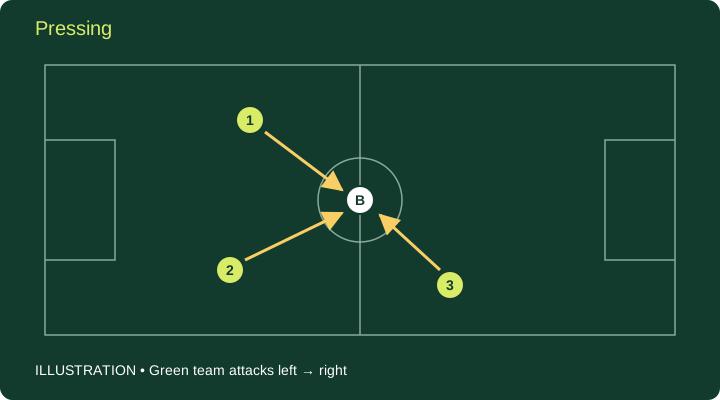
Pressing applies pressure to the ball carrier and nearby options to reduce their time and space. To understand a team’s press, watch both the player closing down and those supporting the move.
Reading the diagram
A back pass or poor touch can be the cue to step forward. Watch whether teammates react together.
This original FootballCap diagram does not depict a real match. Green and white markers distinguish the teams. Solid lines show movement; dashed lines show passes where present. Positions are not drawn to real-world distance scale.
Common misconceptions
Pressing does not always mean making a tackle or immediately winning possession. Forcing a backward, long, or wide pass can also be a meaningful outcome.
Try it yourself
Place three options around the ball carrier. Have the defending group steer play toward one side and see which option remains available.
Keep observations separate from explanations. Test tactical ideas on the tactics board. For metrics, establish the definition and data source before calculating.
Related terms
References
- Coaches’ Voice — In Focus: High press
Source checked: 2026-09-09
Links for further reading; source images, videos, and data are not reproduced.