 Football
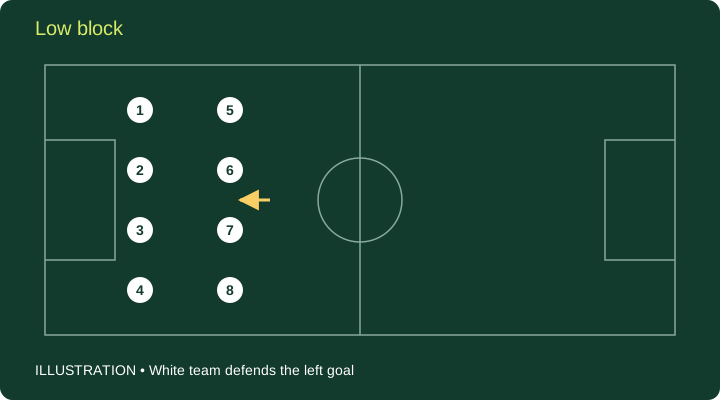
A low block is a defensive structure concentrated near a team’s own goal, prioritizing protection of the defensive third and the spaces between the lines.
Reading the diagram
The white players sit close to the left goal. Record where pressure begins and the distance between the first defensive line and the back line, not just the center backs’ positions.
This original FootballCap diagram does not depict a real match. Green and white markers distinguish the teams. Solid lines show movement; dashed lines show passes where present. Positions are not drawn to real-world distance scale.
Common misconceptions
A low block does not mean a team never presses. Players can step out when conditions suit them, and the term does not imply one fixed formation.
Try it yourself
Imagine the ball is on a wing. Shift the block toward it and locate the space on the far side. Who can protect that area if play switches?
Keep observations separate from explanations. Test tactical ideas on the tactics board. For metrics, establish the definition and data source before calculating.
Related terms
References
- Coaches’ Voice — The low block
Source checked: 2026-09-09
Links for further reading; source images, videos, and data are not reproduced.