 Football
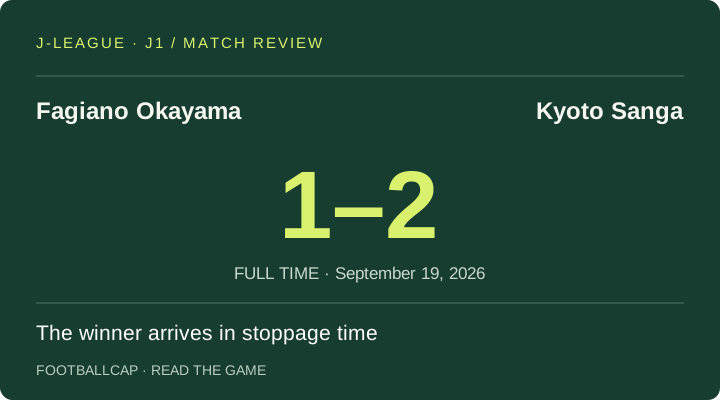
Kyoto Sanga won 2–1 at Fagiano Okayama on September 19, with Alex Souza scoring in second-half stoppage time. Okayama had spent much of the second half a player down, but Kyoto still needed a late breakthrough to take all three points.
A lead, an equalizer, then a dismissal
Joao Pedro opened the scoring for Kyoto in the tenth minute. Na Sang-ho equalized in first-half stoppage time, taking the teams into the break at 1–1.
The official league record confirms Alex Souza’s winner at 90+2. Kyoto’s match data records him entering at halftime and Okayama’s Lucao being sent off in the 57th minute. The winner came after a long period in which the teams had unequal numbers but an equal score.
An extra player still needs a useful position
A numerical advantage is only helpful if the ball can reach the free player. A defending team can remain difficult to break down by concentrating its remaining players near goal and accepting that some distant spaces will be unoccupied.
The attacking question is how to move the block without losing protection behind the ball. A switch of play can make defenders travel across the field. An overload can give the carrier multiple nearby options. Neither guarantees a chance if the next pass is slow or the receiver cannot face forward.
Those are coaching principles for reviewing the long second-half spell here. The event record establishes the extra player and the late winner; it does not prove that one specific passing pattern produced the breakthrough.
Read the finish in context
It would be easy to summarize a stoppage-time winner as evidence of superior desire. A more useful analysis asks what changed in the final attack: the receiver’s position, the pace of the pass, the defender’s distance, or simply the quality of the finish.
For Okayama, the same replay should examine the outlet after regaining possession. Keeping the ball for an extra pass can help a ten-man team breathe, but that requires support for the player receiving it.
Kyoto ultimately converted their opportunity. The long wait is a reminder that having another player and creating a clear opening are different tasks.
Compare this with Tokyo’s ten-man win over Nagoya.
References
- J.League — official match record
Source checked: 2026-09-21 - Kyoto Sanga — official events and substitutions
Source checked: 2026-09-21
Match facts were checked against the sources below on September 21, 2026. Tactical explanations are FootballCap interpretations of published reporting, not independent full-match or tracking analysis.