 Football
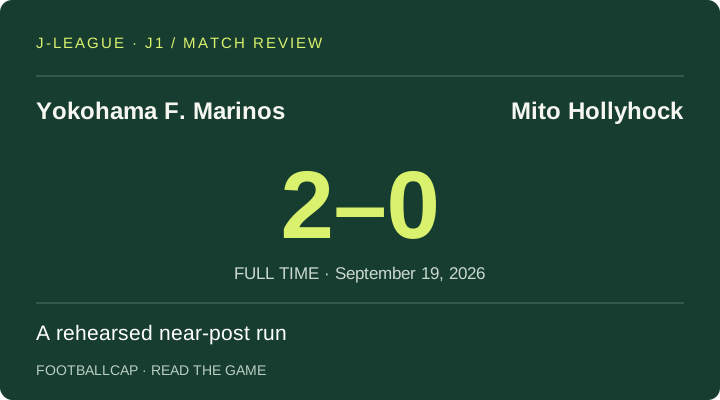
Yokohama F. Marinos beat Mito Hollyhock 2–0 at Nissan Stadium on September 19. Jeisson Quinones scored in the eighth minute, and Riku Yamane added the second in the 83rd.
The most useful detail came afterward: Quinones described the opening goal as the product of work on the training field.
The scorer explained the movement
In comments published on Yokohama’s official website, Quinones said the team had practiced the set piece during the week and that he had been asked to attack the near post. He credited the delivery for giving him the chance to make contact.
That is stronger evidence for a planned routine than simply watching a goal and deciding it must have been rehearsed. The player’s explanation identifies the intended movement, while leaving the exact defensive assignments to be examined separately.
Why attack the near post?
On a set piece, the near post is the post closest to the delivery. A run toward it can shorten the distance the ball travels before an attacker reaches it. The movement can also force a defender to turn while judging the ball’s flight.
Execution depends on timing. Arrive too early and the runner may become stationary; arrive too late and the defender can meet the delivery first. The useful question is when the attacker accelerates relative to the kick, not merely whether the attacker is taller.
That principle explains why repetition in training can matter even when the finished move looks simple.
The second goal brought breathing room
The league record puts Yamane’s goal late in the second half and lists Mito with one shot on target. Yokohama’s lead therefore remained narrow for much of the game, even though Mito’s recorded on-target output was limited.
Avoid treating that single statistic as proof that every defensive action was comfortable. A cross cut out before a shot, for example, never appears as an attempt on target.
For a focused replay, watch the opener once for the delivery and again for Quinones’s starting position and acceleration. Then compare how the defense reacts when another runner moves through the same area.
More explanations are available in J-League and the guide to movement in depth.
References
- J.League — official match record
Source checked: 2026-09-21 - Yokohama F. Marinos — Quinones post-match comments
Source checked: 2026-09-21
Match facts were checked against the sources below on September 21, 2026. Tactical explanations are FootballCap interpretations of published reporting, not independent full-match or tracking analysis.