 Football
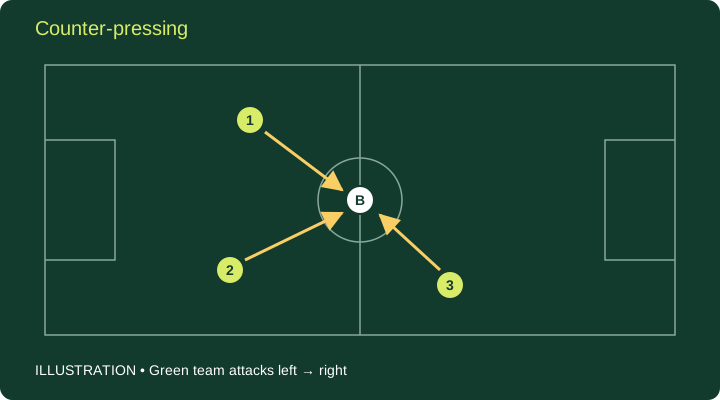
Counter-pressing means applying pressure immediately after losing possession, either to win the ball back or slow the opponent’s buildup. Gegenpressing is the commonly used German term.
Reading the diagram
The green players converge on the point where possession was lost. Watch their immediate reactions and the escape routes available to the new ball carrier.
This original FootballCap diagram does not depict a real match. Green and white markers distinguish the teams. Solid lines show movement; dashed lines show passes where present. Positions are not drawn to real-world distance scale.
Common misconceptions
The defining feature is the timing after a turnover, not simply the location on the field. Not every situation calls for charging forward; the structure behind the press still matters.
Try it yourself
Let an opponent escape with the first pass. Does the green team still have someone to delay the attack and protect the space behind?
Keep observations separate from explanations. Test tactical ideas on the tactics board. For metrics, establish the definition and data source before calculating.
Related terms
References
- Coaches’ Voice — Counter-pressing and gegenpress
Source checked: 2026-09-09
Links for further reading; source images, videos, and data are not reproduced.