 Football
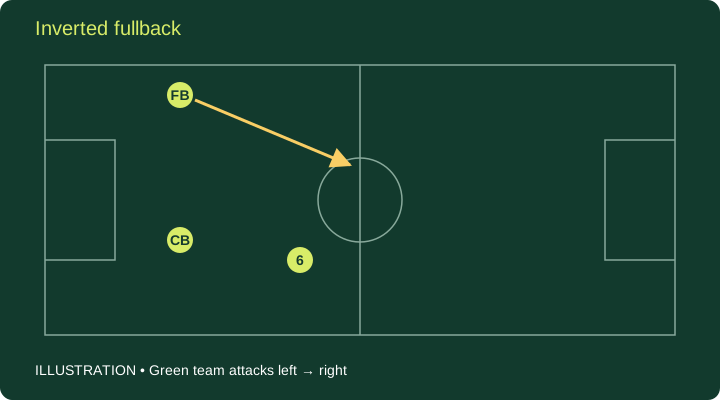
An inverted fullback moves into central areas when the team builds or controls possession. This role can add a supporting player in midfield.
Reading the diagram
The arrow traces a move from the flank toward the middle. Track who supplies width in the fullback’s place and where the holding midfielder positions themselves.
This original FootballCap diagram does not depict a real match. Green and white markers distinguish the teams. Solid lines show movement; dashed lines show passes where present. Positions are not drawn to real-world distance scale.
Common misconceptions
A right-footed player at left back is not automatically an inverted fullback. Here the term describes movement and function, not just the preferred foot.
Try it yourself
Move a fullback into the center. If possession is lost, who protects the wide channel they left behind?
Keep observations separate from explanations. Test tactical ideas on the tactics board. For metrics, establish the definition and data source before calculating.
Related terms
References
- Coaches’ Voice — Inverted full-backs
Source checked: 2026-09-09
Links for further reading; source images, videos, and data are not reproduced.