 Football
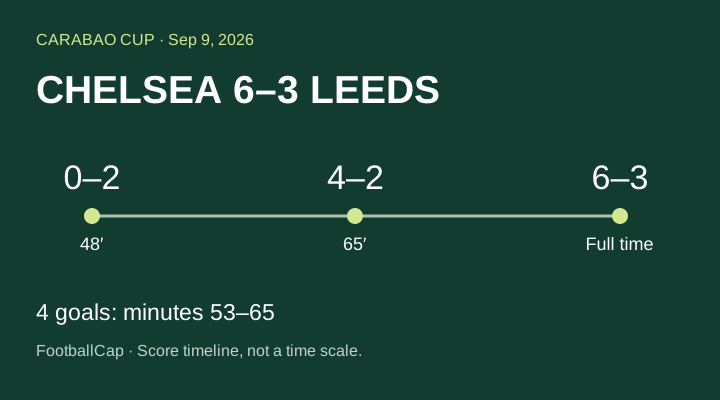
Chelsea beat Leeds United 6–3 at Stamford Bridge on September 9, 2026, in the Carabao Cup third round. Two goals behind early in the second half, the hosts scored four times between the 53rd and 65th minutes. Cole Palmer and Danny Welbeck each scored twice; Pedro Neto and Valentín Barco added the others. Chelsea advanced to round four. Chelsea report.
Nine goals and three shifts in momentum
| Minute | Scorer | Chelsea – Leeds |
|---|---|---|
| 23 | Tarik Muharemovic | 0–1 |
| 48 | Brenden Aaronson | 0–2 |
| 53 | Cole Palmer — penalty | 1–2 |
| 55 | Cole Palmer | 2–2 |
| 60 | Pedro Neto | 3–2 |
| 65 | Danny Welbeck | 4–2 |
| 75 | Dominic Calvert-Lewin | 4–3 |
| 80 | Valentín Barco | 5–3 |
| 90+4 | Danny Welbeck | 6–3 |
Times follow Sky Sports. The table gives eight second-half goals, six for Chelsea. “Four in 12 minutes” is the interval between the 53rd and 65th-minute entries, not a measure of possession time.
Starting lineups: read the shape before the score
FootballCap recreated the following illustrations from pre-match lineup diagrams supplied by the project owner. They show an illustrative arrangement, not average positions or movement maps.
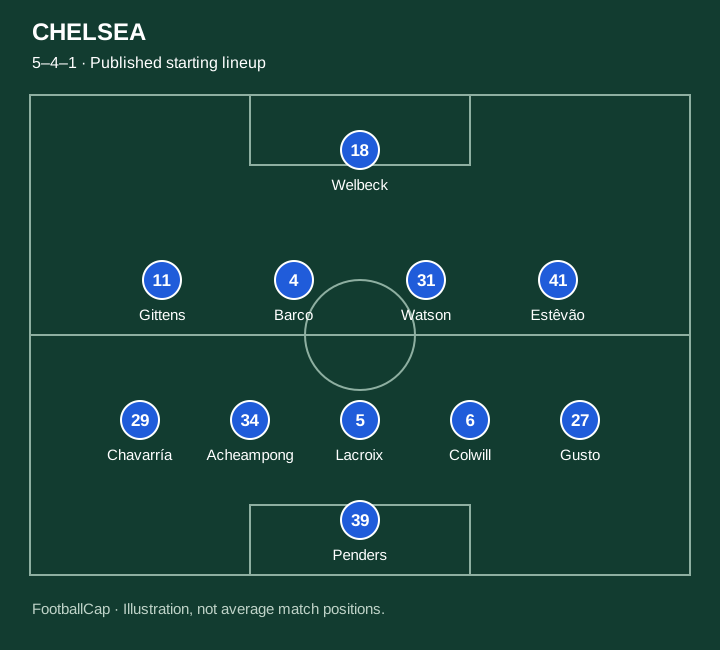
Chelsea: Mike Penders; Josh Acheampong, Maxence Lacroix, Levi Colwill; Malo Gusto, Reggie Watson, Valentín Barco, Pep Chavarría; Estêvão Willian, Danny Welbeck, Jamie Gittens.
The broadcast graphic presented a 5–4–1. The club report described three center backs and two wingbacks, players working up and down the flanks. Neither presentation proves that Chelsea always defended deep or attacked in one fixed shape. Chelsea FC.
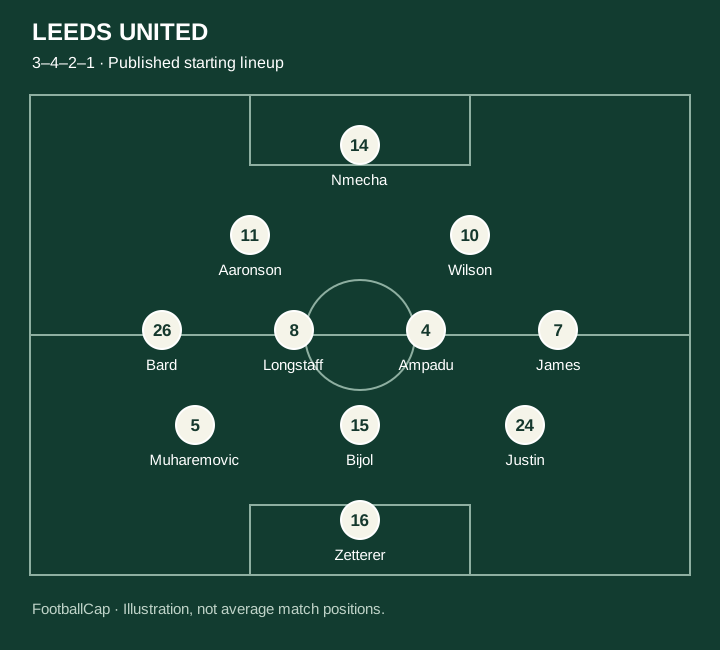
Leeds: Michael Zetterer; James Justin, Jaka Bijol, Tarik Muharemovic; Daniel James, Ethan Ampadu, Sean Longstaff, Melvin Bard; Harry Wilson, Lukas Nmecha, Brenden Aaronson.
Leeds are illustrated in a 3–4–2–1, with Aaronson and Wilson behind Nmecha. Their placement between midfield and attack supplies a question for video review; it does not prove they repeatedly received between the lines.
Leeds’ advantage and Chelsea’s bench response
Muharemovic put Leeds ahead, and Aaronson doubled the lead just after halftime. Chelsea had already introduced Palmer, Morgan Rogers, Neto, and Reece James at the break. The 0–2 goal therefore came after those substitutions; it did not directly cause all four changes. Chelsea FC.
FootballCap’s reading: a substitution and its effect need not appear simultaneously. Examine the combinations that follow. Looking only at the 48th-minute concession risks missing the substitutes’ accumulating influence; looking only at 6–3 risks overlooking the dangers Chelsea continued to face.
Palmer finished; Rogers connected
Palmer’s penalty began the recovery. He equalized two minutes later, before Neto and Welbeck made it 4–2. Rogers assisted the goals in the 55th, 60th, and 65th minutes, highlighting the final-pass provider alongside the scorers. RTÉ.
FootballCap’s reading: effective attacks need both finishers and connectors. On review, ask whether the receiver had time to turn, whether defenders tracked the next movement, and who protected the area where a loose ball might fall. Those questions are more specific than attributing the entire comeback to spirit.
Assist totals alone do not prove Rogers controlled every attack. This article has no full-match passing dataset to compare his involvement with teammates.
A 4–2 lead was not complete control
Calvert-Lewin made it 4–3 in the 75th minute. Barco restored the two-goal cushion five minutes later, and Welbeck completed the scoring in stoppage time. Chelsea still had work to do after the early second-half burst.
FootballCap’s reading: scoring and protecting a lead require separate assessment. Was Chelsea’s rest defense organized with enough players and supporting distances? How did Leeds preserve their spacing after conceding the equalizer? Without full-match video and positional data, this article does not attribute all six concessions to one system.
What the match leaves us with
The shift from 0–2 to 4–2 and the halftime substitutes’ contributions define the game. Palmer began the comeback with two goals, while Rogers connected the moves that put Chelsea ahead. The later 4–3 score is a reminder that attacking superiority does not automatically provide defensive security.
Data scope: this article uses the reported scoring sequence, published lineups, and cross-checked accounts. It does not assign unverified xG, PPDA, or possession numbers. Player names follow the lineups and match reports rather than errors in an automated transcript.
Read more: Rest defense · Carabao Cup articles · Tactics board.
References
- Chelsea FC — Match report: Chelsea 6–3 Leeds United
Source checked: 2026-09-10 - Sky Sports — Chelsea 6–3 Leeds: report and scoring timeline
Source checked: 2026-09-10 - RTÉ — Chelsea produce stunning blitz to beat Leeds in Carabao Cup
Source checked: 2026-09-10
Edited from text and lineup images supplied by the project owner; compared with Chelsea, Sky Sports, and RTÉ reports on September 10, 2026. FootballCap created the illustrations without reusing broadcast images. Tactical interpretation is not full-match tracking analysis.