 Football
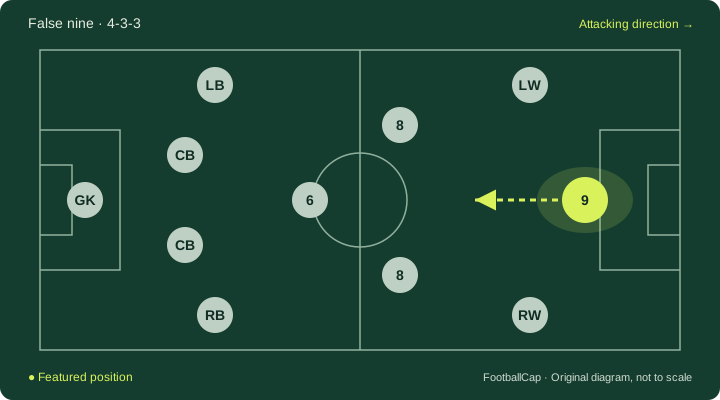
What is a false nine, and where do they play?
A center forward who drops from a high starting position to receive and connect play. The name does not mean the team always leaves the penalty area empty or that the player has no scoring responsibility.
The diagram uses a 4-3-3 setup, attacking from left to right. Yellow markers identify the position being discussed; they are not average match coordinates. For left/right pairs, the top of the diagram is the attacking team’s left side.
Responsibilities in three phases
- In possession: Drop away from the center backs to receive between the lines, combine, and create conditions for teammates to run into space.
- Out of possession: Carry out the first line’s defensive responsibilities. Dropping to receive does not provide an exemption from pressing.
- Transitions: After regaining possession, choose between offering close support and maintaining a threat higher up. Coordinate movement with the wide attackers.
The tactical discussion draws on Coaches’ Voice — The false nine. The wording and exercise below are FootballCap’s own.
Position versus role
Not every striker who drops deep is a false nine. Look for a recurring organizing principle and identify who replaces that player as the threat in behind.
Historical data: the Forward group
| Measure in the historical dataset | Result |
|---|---|
| Records labeled Forward | 720 |
| Records with height greater than zero | 704 |
| Records without a valid height | 16 |
| Median height, cm | 182 |
Source: Players — Pappalardo et al. (2019), CC BY 4.0. FootballCap recalculated these values from the original file. This is a transformed summary, not a table supplied by the authors.
Limitations: The dataset uses four broad labels and does not isolate Center-forward role. These are historical player records pooled across competitions, not appearances or current-season statistics. Height does not measure tactical ability and is not a selection threshold. Do not use this figure as a standard height for this position. See the methods, four groups, and downloads.
What to watch
A touch map may suggest receiving locations, but video is needed to establish starting positions. The Forward dataset below does not classify false nines or measure their ability to draw defenders out.
A position-reading exercise
Use a 4-3-3 and drop the center forward toward midfield. First have a center back follow, then have the defender stay. Make a winger run diagonally in both cases and compare receiving opportunities. Do not assume a defender will always be drawn out.
Use three columns: what you see, alternative options, and what you cannot yet conclude. These are original exercises; repetitions on the tactics board are not player-performance data.
Keep exploring: Depth · All football positions · Open the tactics board.
References
- Coaches’ Voice — The false nine
Source checked: 2026-09-09 - Pappalardo et al. (2019) — Players, CC BY 4.0
Source checked: 2026-09-09 - Creative Commons Attribution 4.0 License
Source checked: 2026-09-09
FootballCap summarized Pappalardo et al. (2019), Players, CC BY 4.0, excluding missing heights and calculating medians. Coaching sources are paraphrased and linked; their images and videos are not reproduced.